Imperivm Art · Roma
From the Forum to the Colosseum, then and now
What did the Roman Forum and the Colosseum look like around AD 320, and what do they look like today? This scrolling walk shows it stop by stop: real photographs of today, declared AI reconstructions, ancient authors with their sources. By Imperivm Art, a shop of Roman reproductions at Via Cavour 280, a five-minute walk from the Colosseum.
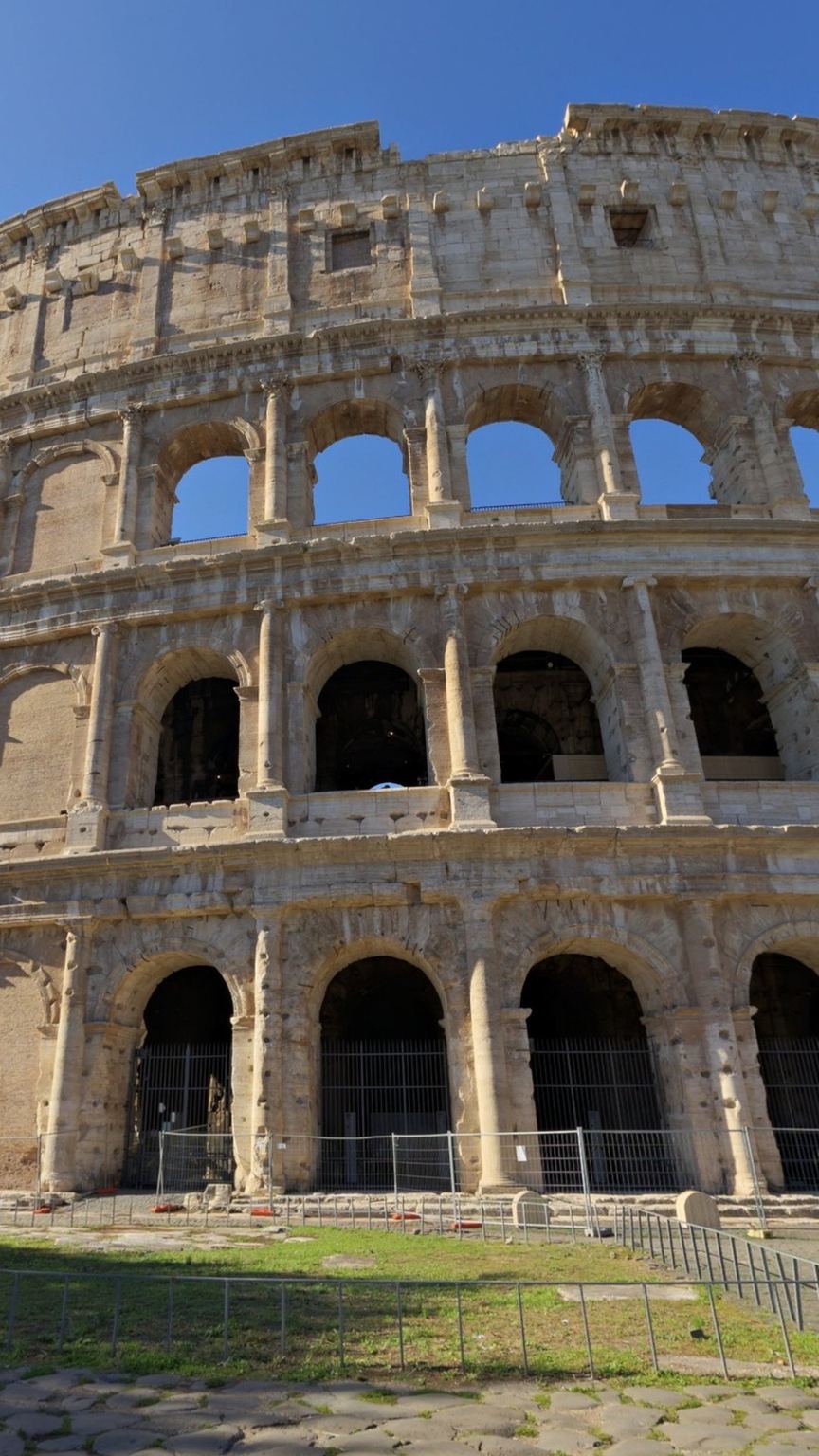
COLOSSEUM · east side · Photograph · 8 November 2017, morningThis is a photograph. It was taken on the morning of 8 November 2017.
What does a Roman see from this same spot, in the year 320?
Today

Then · AI reconstruction, not a photo

Keep scrolling. This is not a photograph. It is a reconstruction, and it says so.
Scroll back, and today returns. From the Forum to the Colosseum, and a little beyond, you will see both.
Today is always a photograph. The past is always a reconstruction, and it always says so.
The route
Scroll, and you walk from the Roman Forum to the Colosseum and on to a door in Via Cavour. At every stop you see the place as it is today and as it may have looked around AD 320.
Timeline
- Late 7th c. BC The Forum marsh is drained — Colosseum Archaeological Park
- AD 80 Titus inaugurates the Flavian Amphitheatre — Italian Ministry of Culture, Platner and Ashby, 1929
- AD 315 The Senate dedicates the Arch of Constantine — Colosseum Archaeological Park
- AD 320 The moment of our reconstructions
- 1822 The Arch of Titus is taken down and rebuilt — Platner and Ashby, 1929, Colosseum Archaeological Park
- 1932 Via dell'Impero opens, today's Via dei Fori Imperiali — Sovrintendenza Capitolina
- 2013–2026 Today's photographs on this page — Wikimedia Commons
I. The Forum
A marsh, then a square


First there is a marsh. At the end of the seventh century BC it is drained, and the valley becomes a square.
The Arch of Septimius Severus in the Roman Forum dates from AD 203; it is 23 metres (75 ft) high and 25 metres (82 ft) wide. — Colosseum Archaeological Park, Platner and Ashby, 1929For more than a thousand years, Rome's public life passes through here.
In 283 a great fire strikes. Diocletian and his successors rebuild.
That is the square a Roman crosses in the year 320. One road cuts across it: the Sacred Way.
Facts and sources for this chapter
In brief, with sources
- The Roman Forum was originally a marsh, drained at the end of the 7th century BC. — Colosseum Archaeological Park
- In AD 283 a great fire struck the Roman Forum; Diocletian and his successors rebuilt it. — Platner and Ashby, 1929
- The last monument of the Roman Forum is the column dedicated to the emperor Phocas in AD 608. — Colosseum Archaeological Park, Platner and Ashby, 1929
Sources
- Samuel Ball Platner, Thomas Ashby, A Topographical Dictionary of Ancient Rome, Oxford University Press, 1929, entry «Sacra Via»
- Samuel Ball Platner, Thomas Ashby, A Topographical Dictionary of Ancient Rome, Oxford University Press, 1929, entry «Forum Romanum»
- Samuel Ball Platner, Thomas Ashby, A Topographical Dictionary of Ancient Rome, Oxford University Press, 1929, entries «Arcus Septimii Severi» and «Columna Phocae»
- Wikimedia Commons: author, licence and date of each photograph
- Colosseum Archaeological Park, «The Roman Forum»
II. The Sacred Way
The same name, another road


Today

Then · AI reconstruction, not a photo


A Roman poet walks along the Sacred Way, lost in some small thought. He writes it down.
«Ibam forte via sacra, sicut meus est mos.»
“I happened to be walking along the Sacred Way, as I usually do.” (Our translation)
The name is the same. The road is not.
Under the emperors it becomes an avenue about thirty metres wide, lined with porticoes and shops.
Its paving is removed in 1899. Beneath it lies an older, narrower road.
The Temple of Antoninus and Faustina has six cipollino marble columns 17 metres (56 ft) high; since the 7th century it has been a church. — Colosseum Archaeological ParkBeside it, a temple becomes a church. Ahead, an arch is waiting.
In 320 there is no church here: the temple has its staircase, its pediment and its marble-faced cella. — Colosseum Archaeological Park
The columns and the inscription are the same as then. The church behind the columns was rebuilt in 1602. — Colosseum Archaeological Park
Faustina died in AD 140; in 161 the Senate dedicated the temple to Antoninus Pius as well. — Colosseum Archaeological ParkThe lines of the inscription, marked by us on the real photograph.
Facts and sources for this chapter
In brief, with sources
- After Hadrian the Sacred Way was an avenue about 30 metres (98 ft) wide, lined with porticoes and shops. — Platner and Ashby, 1929
- The later paving of the Sacred Way, 23 metres (75 ft) wide with its sidewalks, was removed in 1899; the Augustan paving was 5 metres (16 ft) wide. — Platner and Ashby, 1929
Sources
III. The Basilica of Maxentius
One begins it, another signs it


In 308 Maxentius begins a basilica here. Four years later he is defeated by Constantine.
The winner finishes the building and opens an entrance on the Sacred Way.
«…urbis fanum atque basilicam Flavii meritis patres sacravere.»
“…the temple of the City and the basilica, the senators dedicated to the merits of Flavius.” (Our translation)
The central nave of the Basilica of Maxentius was 35 metres (115 ft) high; the building stood on a platform of 100 by 65 metres (328 by 213 ft). — Platner and Ashby, 1929The Senate puts Maxentius' works in his name, Aurelius Victor writes. In one apse, a colossal statue of the emperor is set up.
Today one aisle in three remains. Of the eight marble columns, one survives. It is no longer here.
Facts and sources for this chapter
In brief, with sources
- Maxentius began the Basilica on the Velia in AD 308; Constantine finished it and opened an entrance towards the Sacred Way with four porphyry columns. — Colosseum Archaeological Park
- Of the Basilica only the north aisle survives today, with three great coffered vaults. — Colosseum Archaeological Park
- The one surviving column of the nave's eight, with a shaft of 14.50 metres (48 ft), was moved in 1613 to Piazza di Santa Maria Maggiore. — Platner and Ashby, 1929
Sources
- Samuel Ball Platner, Thomas Ashby, A Topographical Dictionary of Ancient Rome, Oxford University Press, 1929, entry «Basilica Constantini»
- Wikimedia Commons: author, licence and date of each photograph
- Aurelius Victor, De Caesaribus 40.26
- Colosseum Archaeological Park, «Basilica of Maxentius» (English and Italian pages)
- Colosseum Archaeological Park, «Arch of Constantine and Meta Sudans»
IV. The Arch of Titus
Taken apart and rebuilt


Today

Then · AI reconstruction, not a photo


This arch looks whole. It is not.
In the Middle Ages it ends up inside a fortress. In the 1820s it is taken apart, piece by piece, and rebuilt.
The Arch of Titus is 15.40 metres (50.5 ft) high and 13.50 metres (44.3 ft) wide. — Platner and Ashby, 1929Where the ancient marble is missing, the architect Valadier uses travertine.
Inside, the spoils of the Jewish War go by, with a seven-branched lampstand.
The other side of the arch, facing the Colosseum.
The dedication to Titus, now a god, is on the other side, facing the Colosseum.
SENATVS POPVLVSQVE ROMANVS DIVO TITO DIVI VESPASIANI F VESPASIANO AVGVSTO
“The Senate and People of Rome to the deified Titus Vespasian Augustus, son of the deified Vespasian.” (Our translation)
In 320 the arch is all marble. The travertine arrives in 1822, with Valadier's restoration. — Platner and Ashby, 1929, Colosseum Archaeological Park
Inside the circle: today. The centre, with the dedication, the frieze and the reliefs, is the same marble as then; most of the attic and the outer half of the piers are travertine. — Platner and Ashby, 1929, Colosseum Archaeological Park
Facts and sources for this chapter
In brief, with sources
- In 1822 the Arch of Titus was taken down and rebuilt by Giuseppe Valadier, who replaced the missing parts in travertine. — Platner and Ashby, 1929, Colosseum Archaeological Park
- The ancient dedication of the Arch of Titus, CIL VI 945, is on the attic facing the Colosseum. — CIL VI 945, Colosseum Archaeological Park
- The relief inside the passage shows the spoils of the Jewish War, which ended in AD 71, with the seven-branched lampstand. — Colosseum Archaeological Park
Sources
V. The Temple of Venus and Roma
The emperor as architect


The Temple of Venus and Roma measured over 100 by 50 metres (328 by 164 ft) and stood about 30 metres (98 ft) high; its platform was 145 by 100 metres (476 by 328 ft). — Colosseum Archaeological Park, Platner and Ashby, 1929Here the architect is the emperor. Hadrian draws a temple for two goddesses, Venus and Roma.
First he moves a colossal statue: it takes twenty-four elephants, the Historia Augusta says.
«Transtulit et colossum stantem atque suspensum […] ita ut operi etiam elephantos viginti quattuor exhiberet.»
“He also moved the Colossus, upright and raised off the ground […], using as many as twenty-four elephants for the task.” (Our translation)
Trajan's architect, Apollodorus, receives the plan. The statues are too tall, he says: if the goddesses wished to stand up, they could not.
Hadrian, Cassius Dio writes, does not forgive him.
After a fire in 307, Maxentius rebuilds.
Facts and sources for this chapter
In brief, with sources
- Hadrian had the Temple of Venus and Roma built from AD 121 to his own design; it was inaugurated in 136 or 137 and completed by Antoninus Pius in 141. — Colosseum Archaeological Park
- Moving the Colossus took twenty-four elephants, according to the Historia Augusta. — Historia Augusta, Hadrian 19.12
- The Colossus was 120 feet high according to Suetonius and 100 feet according to Cassius Dio. — Suetonius, Nero 31, Cassius Dio 65 (66).15
Sources
- Samuel Ball Platner, Thomas Ashby, A Topographical Dictionary of Ancient Rome, Oxford University Press, 1929, entry «Templum Veneris et Romae»
- Wikimedia Commons: author, licence and date of each photograph
- Historia Augusta, Hadrian 19.12-13
- Cassius Dio, Roman History 69.4.1-5 (Loeb English translation)
- Suetonius, Nero 31.1 (Loeb English translation)
- Cassius Dio, Roman History 65 (66).15.1 (Loeb English translation)
- Colosseum Archaeological Park, «Temple of Venus and Roma»
Read more: Emperor Hadrian: the bust (reproduction)
VI. The Arch of Constantine
A new arch and a fountain that is gone
Today
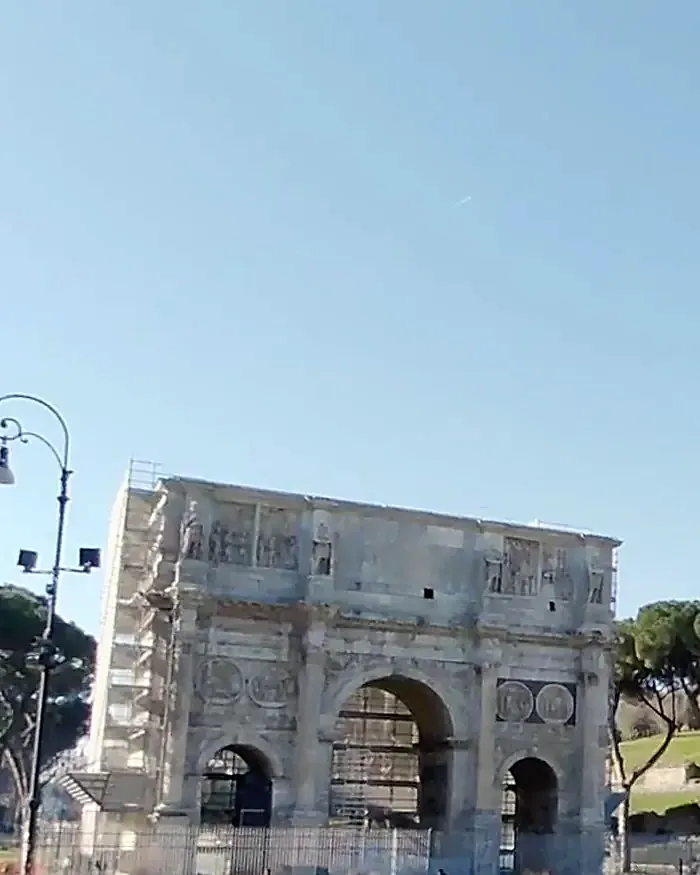
Then · AI reconstruction, not a photo
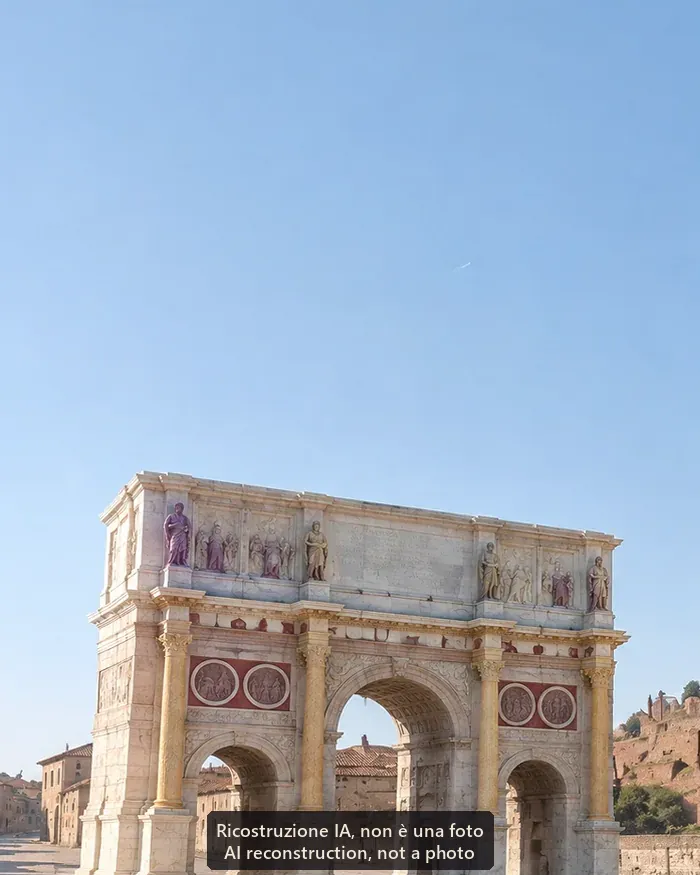
In the year 320 this arch is new.
«…QVOD INSTINCTV DIVINITATIS MENTIS MAGNITVDINE…»
“…because, by the prompting of the divinity and the greatness of his mind…” (Our translation)
The Arch of Constantine is 21 metres (69 ft) high and 25.70 metres (84 ft) wide. — Platner and Ashby, 1929
The Senate dedicates it to Constantine on 25 July 315, for his victory over Maxentius.
Many of its reliefs are older: they come from monuments of Trajan, Hadrian and Marcus Aurelius. The emperors' faces are recarved.
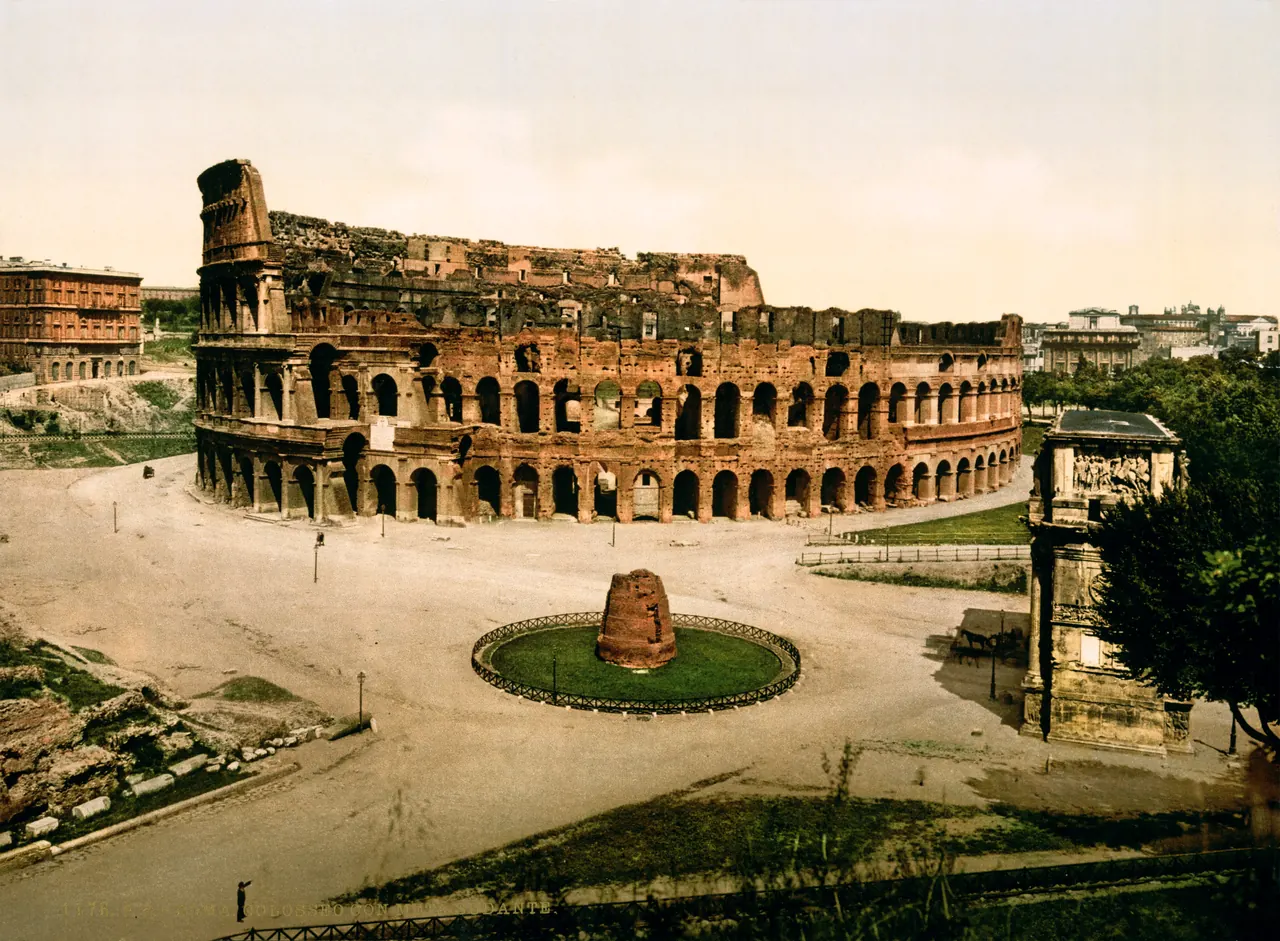
Historical photograph, about 1880-1890, from a different viewpointBeside it, a cone-shaped fountain stays in use until the fifth century.
Its ruins are demolished under Fascism, to open a road. Today its remains can be seen beside the arch.
Facts and sources for this chapter
In brief, with sources
- The Senate dedicated the Arch of Constantine on 25 July AD 315, for the victory over Maxentius at the Milvian Bridge on 28 October 312. — Colosseum Archaeological Park
- Many reliefs on the Arch of Constantine come from monuments of Trajan, Hadrian and Marcus Aurelius, with the faces recarved. — Colosseum Archaeological Park
- The Meta Sudans, a cone-shaped fountain of the Flavian period, stayed in use until the 5th century; its ruins were demolished in the Fascist period to build Via dei Trionfi. — Colosseum Archaeological Park
Sources
- Samuel Ball Platner, Thomas Ashby, A Topographical Dictionary of Ancient Rome, Oxford University Press, 1929, entry «Arcus Constantini»
- Samuel Ball Platner, Thomas Ashby, A Topographical Dictionary of Ancient Rome, Oxford University Press, 1929, entry «Meta Sudans»
- Wikimedia Commons: author, licence and date of each photograph
- CIL VI 1139, dedication of the Arch of Constantine
- Colosseum Archaeological Park, «Arch of Constantine and Meta Sudans»
Read more: Marcus Aurelius on horseback (bronze reproduction)
VII. The Colosseum
Two authors, two counts
Today

Then · AI reconstruction, not a photo

Vespasian began building the Flavian Amphitheatre in AD 72; Titus inaugurated it in 80. — Italian Ministry of Culture
Stop here. Look up.
«amphitheatri molem […] ad cuius summitatem aegre visio humana conscendit»
“the mass of the amphitheatre […], to whose top human sight barely climbs” (Our translation)
The façade of the Colosseum is 48.50 metres (159 ft) high; its two axes measure 188 and 156 metres (617 and 512 ft). — Platner and Ashby, 1929In the photograph of 6 March 2025, three arches of the second storey have white statues.
«hic ubi conspicui uenerabilis Amphitheatri / erigitur moles, stagna Neronis erant»
“Here, where the venerable mass of the Amphitheatre rises in full view, were Nero's pools.” (Our translation)
Where this mass rises, the poet Martial writes, there were Nero's pools.
Cassius Dio calls it the hunting-theatre. Titus opens it, he writes, with games that go on for a hundred days.
Dio counts nine thousand animals killed. For the same celebrations, Suetonius writes of five thousand wild beasts in a single day.
Two authors, two counts. We do not add them up.
A declared jump: the east side of the Colosseum, photographed on another day.
This is where we started.
Facts and sources for this chapter
In brief, with sources
- At ground level the Colosseum had 80 arches, 76 of them numbered. — Platner and Ashby, 1929
- The Italian Ministry of Culture estimates that the Colosseum could hold about 55,000 spectators. — Italian Ministry of Culture
- The last recorded shows in the Colosseum date from AD 523. — Italian Ministry of Culture, Platner and Ashby, 1929
Sources
- Samuel Ball Platner, Thomas Ashby, A Topographical Dictionary of Ancient Rome, Oxford University Press, 1929, entry «Amphitheatrum Flavium»
- Wikimedia Commons: author, licence and date of each photograph
- Cassius Dio, Roman History 66.25.1-4 (Loeb English translation)
- Suetonius, Titus 7.3
- Martial, On the Spectacles (Liber spectaculorum) 2.5-6
- Ammianus Marcellinus, History 16.10.14
- Italian Ministry of Culture, «Carta della qualità dei servizi: Colosseo (Anfiteatro Flavio)», issued 19/07/2024, page 2
Read more: What to see in 2 hours around the Colosseum · The Colosseum, dark stone finish (reproduction)
VIII. The new road
A hill cut away


Here the new thing is the road. Until 1931 a hill stands in its place: the Velia.
In two years it is cut away.
On 20 May 1932, beneath the hill, the skull and a tusk of a prehistoric elephant come to light.
To open the road, 5,500 rooms and 5 churches of the Alessandrino quarter were demolished; 7,000 residents were moved. — Sovrintendenza CapitolinaThe road opens on 28 October.
At the corner with Via Cavour, under the garden, lies one corner of the Forum of Peace.
Photo from 2018. On 3 November 2025 part of the Torre dei Conti collapsed. — Roma Capitale
Facts and sources for this chapter
In brief, with sources
- The Velia hill was cut away in two years, between 1931 and 1932. — Museum of the Imperial Fora
- On 20 May 1932, about 11 metres (36 ft) below the top of the Velia, the skull and a tusk of an Elephas antiquus were found. — Museum of the Imperial Fora
- Via dei Fori Imperiali was inaugurated on 28 October 1932 under the name Via dell'Impero. — Sovrintendenza Capitolina, Museum of the Imperial Fora
- The garden of Largo Corrado Ricci lies over the north-east corner of the Forum of Peace, built by Vespasian between AD 71 and 75. — Sovrintendenza Capitolina
Sources
- Sovrintendenza Capitolina, «La distruzione del Quartiere Alessandrino. La nascita di Via dell'Impero»
- Sovrintendenza Capitolina, «I Fori Imperiali - Notizie sugli scavi», PDF of 13/06/2019
- Trajan's Markets - Museum of the Imperial Fora, exhibition «1932, l'elefante e il colle perduto»
- Turismo Roma (Roma Capitale), «Via dei Fori Imperiali»
- Sovrintendenza Capitolina, «Torre dei Conti»
- Roma Capitale, news items on the Torre dei Conti (03/11/2025 and 19/03/2026)
- Sovrintendenza Capitolina, pages on the Templum Pacis and on Largo Corrado Ricci
Epilogue A door in Via Cavour
The shop, Via Cavour 280

Via Cavour runs through the valley of the ancient Subura.
«Habitavit primo in Subura modicis aedibus, post autem pontificatum maximum in Sacra via domo publica.»
“He lived at first in the Subura, in a modest house; then, after becoming chief priest, on the Sacred Way, in the official residence.” (Our translation)
Caesar, Suetonius writes, lives there first, in a modest house. Later, as chief priest, he lives on the Sacred Way.
We have walked his move in reverse. It ends at a door: Via Cavour 280.
Imperivm Art is at Via Cavour 280, a five-minute walk from the Colosseum, open every day from 10 am to 8 pm. — Imperivm ArtImperivm Art, five minutes on foot from the Colosseum. Inside, reproductions sold as reproductions. No reconstruction here: only photographs of today.
The walk ends at a door
Imperivm ArtVia Cavour 280, 00184 Rome
A five-minute walk from the Colosseum.
Open every day, 10 am to 8 pm.
Statues, busts, helmets and swords: reproductions of Roman art, sold as reproductions.
Photographs of the shop: Imperivm Art.
Imperivm Art · Roma
Facts and sources for this chapter
In brief, with sources
- Via Cavour runs through the valley of the ancient Subura, where Caesar first lived, in a modest house. — Platner and Ashby, 1929, Suetonius, The Deified Julius 46
Sources
Sources and credits
How we worked
The photographs were taken by different people in different years: light and building sites change from one stop to the next. Between two different photographs there is a dissolve. Where the camera moves inside a reconstruction with AI, this is declared in the credits; elsewhere it is a slow move over the still image. The reconstructions show a single moment, around AD 320, and are hypotheses. Every historical fact has its source below. Translations from Latin are ours.
Each reconstruction was generated with AI, starting from the real photograph of the same spot. It follows the sources listed at the end of the page. Where the sources are silent, it shows our hypothesis. It is not a photograph and it is not an archaeological study.
Every comparison is made from the same spot: today's photograph dissolves into the reconstruction with the same camera movement, then the «Today» circle opens as you scroll and shows the real photograph again, aligned. On computers, the ancient stops at the Colosseum use the still reconstruction split into two layers (building and sky, separated by computer without AI) moving at different depths; at the Arch of Constantine and the Temple of Antoninus and Faustina the images sit in a vertical column, cropped as on phones, with today's photograph heavily blurred behind. In some real photographs the sky is separated from the rest by computer, without AI, and moves a little more slowly: it is the same photograph, on two layers.
Today is always a photograph. The past is always a reconstruction, and it always says so.
Sources
Ancient authors
- Horace, Satires (Sermones) 1.9.1-2 · thelatinlibrary.com · read on 13/10/2026
- Cassius Dio, Roman History 66.25.1-4 (Loeb English translation) · penelope.uchicago.edu · read on 13/10/2026
- Suetonius, Titus 7.3 · thelatinlibrary.com · read on 13/10/2026
- Martial, On the Spectacles (Liber spectaculorum) 2.5-6 · thelatinlibrary.com · read on 13/10/2026
- Historia Augusta, Hadrian 19.12-13 · thelatinlibrary.com · read on 13/10/2026
- Cassius Dio, Roman History 69.4.1-5 (Loeb English translation) · penelope.uchicago.edu · read on 13/10/2026
- Ammianus Marcellinus, History 16.10.14 · thelatinlibrary.com · read on 13/10/2026
- Aurelius Victor, De Caesaribus 40.26 · thelatinlibrary.com · read on 13/10/2026
- Suetonius, The Deified Julius (Divus Iulius) 46 · thelatinlibrary.com · read on 13/10/2026
- Suetonius, Nero 31.1 (Loeb English translation) · penelope.uchicago.edu · read on 13/10/2026
- Cassius Dio, Roman History 65 (66).15.1 (Loeb English translation) · penelope.uchicago.edu · read on 13/10/2026
- Suetonius, Vespasian 9.1 · thelatinlibrary.com · read on 13/10/2026
Inscriptions
- CIL VI 945, dedication of the Arch of Titus · penelope.uchicago.edu · read on 13/10/2026
- CIL VI 1139, dedication of the Arch of Constantine · penelope.uchicago.edu · read on 13/10/2026
Official bodies
- Colosseum Archaeological Park, «The Roman Forum» · colosseo.it · read on 13/10/2026
- Colosseum Archaeological Park, «Temple of Antoninus and Faustina» · colosseo.it · read on 13/10/2026
- Colosseum Archaeological Park, «Basilica of Maxentius» (English and Italian pages) · colosseo.it colosseo.it · read on 13/10/2026
- Colosseum Archaeological Park, «Arch of Titus» · colosseo.it · read on 13/10/2026
- Colosseum Archaeological Park, «Temple of Venus and Roma» · colosseo.it · read on 13/10/2026
- Colosseum Archaeological Park, «Arch of Constantine and Meta Sudans» · colosseo.it · read on 13/10/2026
- Colosseum Archaeological Park, «Colosseo» · colosseo.it · read on 13/10/2026
- Italian Ministry of Culture, «Carta della qualità dei servizi: Colosseo (Anfiteatro Flavio)», issued 19/07/2024, page 2 · colosseo.it · read on 13/10/2026
- Sovrintendenza Capitolina, «La distruzione del Quartiere Alessandrino. La nascita di Via dell'Impero» · sovraintendenzaroma.it · read on 13/10/2026
- Sovrintendenza Capitolina, «I Fori Imperiali - Notizie sugli scavi», PDF of 13/06/2019 · sovraintendenzaroma.it · read on 13/10/2026
- Trajan's Markets - Museum of the Imperial Fora, exhibition «1932, l'elefante e il colle perduto» · mercatiditraiano.it · read on 13/10/2026
- Turismo Roma (Roma Capitale), «Via dei Fori Imperiali» · turismoroma.it · read on 13/10/2026
- Sovrintendenza Capitolina, «Torre dei Conti» · sovraintendenzaroma.it · read on 13/10/2026
- Roma Capitale, news items on the Torre dei Conti (03/11/2025 and 19/03/2026) · comune.roma.it comune.roma.it · read on 13/10/2026
- Sovrintendenza Capitolina, pages on the Templum Pacis and on Largo Corrado Ricci · sovraintendenzaroma.it sovraintendenzaroma.it sovraintendenzaroma.it sovraintendenzaroma.it sovraintendenzaroma.it · read on 13/10/2026
- Trajan's Markets - Museum of the Imperial Fora, «Tempio della Pace» · mercatiditraiano.it · read on 13/10/2026
- Sovrintendenza Capitolina, «I Fori Imperiali dal Medioevo ad oggi» · sovraintendenzaroma.it · read on 13/10/2026
Studies
- Samuel Ball Platner, Thomas Ashby, A Topographical Dictionary of Ancient Rome, Oxford University Press, 1929, entry «Sacra Via» · penelope.uchicago.edu · read on 13/10/2026
- Samuel Ball Platner, Thomas Ashby, A Topographical Dictionary of Ancient Rome, Oxford University Press, 1929, entry «Forum Romanum» · penelope.uchicago.edu · read on 13/10/2026
- Samuel Ball Platner, Thomas Ashby, A Topographical Dictionary of Ancient Rome, Oxford University Press, 1929, entry «Arcus Titi» · penelope.uchicago.edu · read on 13/10/2026
- Samuel Ball Platner, Thomas Ashby, A Topographical Dictionary of Ancient Rome, Oxford University Press, 1929, entry «Arcus Constantini» · penelope.uchicago.edu · read on 13/10/2026
- Samuel Ball Platner, Thomas Ashby, A Topographical Dictionary of Ancient Rome, Oxford University Press, 1929, entry «Amphitheatrum Flavium» · penelope.uchicago.edu · read on 13/10/2026
- Samuel Ball Platner, Thomas Ashby, A Topographical Dictionary of Ancient Rome, Oxford University Press, 1929, entry «Colossus Neronis» · penelope.uchicago.edu · read on 13/10/2026
- Samuel Ball Platner, Thomas Ashby, A Topographical Dictionary of Ancient Rome, Oxford University Press, 1929, entry «Meta Sudans» · penelope.uchicago.edu · read on 13/10/2026
- Samuel Ball Platner, Thomas Ashby, A Topographical Dictionary of Ancient Rome, Oxford University Press, 1929, entry «Basilica Constantini» · penelope.uchicago.edu · read on 13/10/2026
- Samuel Ball Platner, Thomas Ashby, A Topographical Dictionary of Ancient Rome, Oxford University Press, 1929, entry «Templum Veneris et Romae» · penelope.uchicago.edu · read on 13/10/2026
- Samuel Ball Platner, Thomas Ashby, A Topographical Dictionary of Ancient Rome, Oxford University Press, 1929, entry «Templum Pacis» · penelope.uchicago.edu · read on 13/10/2026
- Samuel Ball Platner, Thomas Ashby, A Topographical Dictionary of Ancient Rome, Oxford University Press, 1929, entries «Subura» and «Argiletum» · penelope.uchicago.edu penelope.uchicago.edu · read on 13/10/2026
- Samuel Ball Platner, Thomas Ashby, A Topographical Dictionary of Ancient Rome, Oxford University Press, 1929, entries «Arcus Septimii Severi» and «Columna Phocae» · penelope.uchicago.edu penelope.uchicago.edu · read on 13/10/2026
- Samuel Ball Platner, Thomas Ashby, A Topographical Dictionary of Ancient Rome, Oxford University Press, 1929, entry «Equus Constantini» · penelope.uchicago.edu · read on 13/10/2026
- Samuel Ball Platner, Thomas Ashby, A Topographical Dictionary of Ancient Rome, Oxford University Press, 1929, entry «Rostra Augusti» · penelope.uchicago.edu · read on 13/10/2026
- Samuel Ball Platner, Thomas Ashby, A Topographical Dictionary of Ancient Rome, Oxford University Press, 1929, entry «Velia» · penelope.uchicago.edu · read on 13/10/2026
- The Chronography of 354 AD, Part 6: the calendar of Philocalus (online edition at tertullian.org) · tertullian.org · read on 13/10/2026
Other data
- Wikimedia Commons: author, licence and date of each photograph · commons.wikimedia.org · read on 13/10/2026
- Imperivm Art: shop details (address, hours) as on this website ·
Photographs
The photographs are by the authors named on each image, from Wikimedia Commons, under the licences shown. We host the files ourselves. Crops, resizing and conversions are declared in the list. Modified versions of the CC BY-SA photographs, including the reconstructions made from them, are shared under the same licence.
- The Colosseum, east side · Greg Zaal and Rico Cilliers (Poly Haven) · CC0 · 8 November 2017 (Poly Haven) · file on Wikimedia Commons
a rectilinear view computed from the 360-degree photo, without AI, resized and converted to WebP: on the page the views 864 x 1536, 1080 x 1350 and 1920 x 1080 (the 360-degree photo itself is not published) - The Roman Forum from the Capitoline Hill · Diego Delso · CC BY-SA 4.0 · 16 September 2022 · file on Wikimedia Commons
saved at 2560 x 1361, 1280 x 681 px (never enlarged) and converted from JPEG to WebP; 64 px blurred placeholder; in the walk, the sky separated from the rest by computer, without AI, for a slight parallax (two layers of the same photo) - The Forum looking east: the Arch of Titus and the Colosseum in the distance · Nicholas Hartmann · CC BY-SA 4.0 · 11 September 2019 · file on Wikimedia Commons
colours converted from the Adobe RGB (1998) profile to sRGB; saved at 2560 x 1707, 1280 x 853 px (never enlarged) and converted from JPEG to WebP; 64 px blurred placeholder; for phones, a vertical 9:16 crop converted to WebP; in the walk, the sky separated from the rest by computer, without AI, for a slight parallax (two layers of the same photo) - The Via Sacra, with the Arch of Titus in the distance · Yelobrd · CC BY-SA 4.0 · 29 April 2014 · file on Wikimedia Commons
cropped to remove recognisable people (2273 x 2848 px kept of the original 4288 x 2848); saved at 2043 x 2560, 1022 x 1280 px (never enlarged) and converted from JPEG to WebP; 64 px blurred placeholder; for phones, a vertical 9:16 crop converted to WebP - The Via Sacra climbing, with its paving stones · Robot8A · CC BY-SA 4.0 · 20 June 2021 · file on Wikimedia Commons
saved at 2560 x 1920, 1280 x 960 px (never enlarged) and converted from JPEG to WebP; 64 px blurred placeholder; for phones, a vertical 9:16 crop converted to WebP - The Temple of Antoninus and Faustina seen from below · Paolo Villa · CC BY-SA 4.0 · 28 April 2022 · file on Wikimedia Commons
resized and converted to WebP: on the page 1200 x 1811 and a 4:5 crop of 1080 x 1350, and on computers the same photo heavily blurred behind the column (never enlarged) - Temple of Antoninus and Faustina: the inscription on the architrave · Nicholas Hartmann · CC BY-SA 4.0 · 11 September 2019 · file on Wikimedia Commons
colours converted from the Adobe RGB (1998) profile to sRGB; saved at 2560 x 1920, 1280 x 960 px (never enlarged) and converted from JPEG to WebP; 64 px blurred placeholder; for phones, a vertical 9:16 crop converted to WebP - The Basilica of Maxentius from the Via Sacra · Robot8A · CC BY-SA 4.0 · 20 June 2021 · file on Wikimedia Commons
saved at 2560 x 1920, 1280 x 960 px (never enlarged) and converted from JPEG to WebP; 64 px blurred placeholder; for phones, a vertical 9:16 crop converted to WebP - The Basilica of Maxentius in its setting · Julian Lupyan · CC0 · 7 June 2026 · file on Wikimedia Commons
saved at 2560 x 1592, 1280 x 796 px (never enlarged) and converted from JPEG to WebP; 64 px blurred placeholder; for phones, a vertical 9:16 crop converted to WebP; in the walk, the sky separated from the rest by computer, without AI, for a slight parallax (two layers of the same photo) - The three vaults of the Basilica of Maxentius · Tournasol7 · CC BY-SA 4.0 · 13 November 2018 · file on Wikimedia Commons
saved at 2560 x 1378, 1280 x 689 px (never enlarged) and converted from JPEG to WebP; 64 px blurred placeholder; for phones, a vertical 9:16 crop converted to WebP; in the walk, the sky separated from the rest by computer, without AI, for a slight parallax (two layers of the same photo) - The Arch of Titus and, behind it, the Colosseum · Bradley Weber · CC BY 2.0 · 7 February 2019 · file on Wikimedia Commons
saved at 2560 x 1707, 1280 x 853 px (never enlarged) and converted from JPEG to WebP; 64 px blurred placeholder; for phones, a vertical 9:16 crop converted to WebP - The Arch of Titus, Forum side (west) · Jebulon · CC0 · 22 August 2013 · file on Wikimedia Commons
saved at 2560 x 2375, 1280 x 1188 px (never enlarged) and converted from JPEG to WebP; 64 px blurred placeholder; for phones, a vertical 9:16 crop converted to WebP; in the walk, the sky separated from the rest by computer, without AI, for a slight parallax (two layers of the same photo) - Arch of Titus, inner relief with the seven-branched lampstand · Jebulon · CC0 · 22 August 2013 · file on Wikimedia Commons
saved at 2560 x 1771, 1280 x 886 px (never enlarged) and converted from JPEG to WebP; 64 px blurred placeholder; for phones, a vertical 9:16 crop converted to WebP - The Arch of Titus, Colosseum side (east), with the ancient dedication · Another Believer · CC BY-SA 4.0 · 28 November 2025 · file on Wikimedia Commons
colours converted from the Display P3 profile to sRGB; resized and converted to WebP: on the page 1600 x 1200, 1920 x 1440 and a 4:5 crop of 1080 x 1350 (never enlarged) - The columns of the Temple of Venus and Roma, with the Colosseum behind · Wilfredor · CC0 · 13 February 2024 · file on Wikimedia Commons
colours converted from the ProPhoto RGB profile to sRGB; cropped to remove recognisable people (7076 x 5029 px kept of the original 7076 x 5266); saved at 2560 x 1819, 1280 x 910 px (never enlarged) and converted from JPEG to WebP; 64 px blurred placeholder; for phones, a vertical 9:16 crop converted to WebP; in the walk, the sky separated from the rest by computer, without AI, for a slight parallax (two layers of the same photo) - The Temple of Venus and Roma from above, with the Arch of Titus and Via dei Fori Imperiali · daryl_mitchell · CC BY-SA 2.0 · 7 June 2014 · file on Wikimedia Commons
saved at 2560 x 1920, 1280 x 960 px (never enlarged) and converted from JPEG to WebP; 64 px blurred placeholder; for phones, a vertical 9:16 crop converted to WebP - Temple of Venus and Roma: the apse with its coffered vault · Diego Delso · CC BY-SA 4.0 · 15 September 2022 · file on Wikimedia Commons
saved at 2560 x 1707, 1280 x 853 px (never enlarged) and converted from JPEG to WebP; 64 px blurred placeholder; for phones, a vertical 9:16 crop converted to WebP - The Arch of Constantine from the Colosseum side · mapconcierge (Mapillary) · CC BY-SA 4.0 · 6 March 2025 · file on Wikimedia Commons
retouched: the photographer, visible at the bottom of the 360-degree photo, is covered with paving cloned from the same photo (clone stamp with a feathered edge, no AI); a rectilinear view computed from the 360-degree photo, without AI, cropped above the crowd: on the page the views 864 x 1072 and 700 x 875, and on computers the same photo heavily blurred behind the column (the 360-degree photo itself is not published); colours and contrast adjusted by computer, without AI - The Colosseum and the remains of the Meta Sudans, late nineteenth century · Detroit Publishing Co., under licence from Photoglob Zürich (Library of Congress) · Public domain · between 1880 and 1890 · file on Wikimedia Commons
saved at 2560 x 1882, 1280 x 941 px (never enlarged) and converted from JPEG to WebP; 64 px blurred placeholder - North side of the Colosseum · mapconcierge (Mapillary) · CC BY-SA 4.0 · 6 March 2025 · file on Wikimedia Commons
retouched: the photographer, visible at the bottom of the 360-degree photo, is covered with paving cloned from the same photo (clone stamp with a feathered edge, no AI); a rectilinear view computed from the 360-degree photo, without AI, framed above the crowd: on the page the views 864 x 1536, 1080 x 1350 and 1920 x 1080 (the 360-degree photo itself is not published) - Via dei Fori Imperiali: the Basilica of Maxentius seen from the road · Chabe01 · CC BY-SA 4.0 · 30 August 2021 · file on Wikimedia Commons
colours converted from the Display P3 profile to sRGB; saved at 2560 x 1920, 1280 x 960 px (never enlarged) and converted from JPEG to WebP; 64 px blurred placeholder; for phones, a vertical 9:16 crop converted to WebP; in the walk, the sky separated from the rest by computer, without AI, for a slight parallax (two layers of the same photo) - Via dei Fori Imperiali, the stretch towards Piazza Venezia · Jorge Franganillo · CC BY 2.0 · 4 September 2022 · file on Wikimedia Commons
saved at 2560 x 1440, 1280 x 720 px (never enlarged) and converted from JPEG to WebP; 64 px blurred placeholder; for phones, a vertical 9:16 crop converted to WebP - Largo Corrado Ricci, where Via Cavour begins · Sonse · CC BY 2.0 · 14 November 2018 · file on Wikimedia Commons
colours converted from the Apple Wide Color Sharing Profile profile to sRGB; cropped to remove recognisable people (5472 x 2918 px kept of the original 5472 x 3648); saved at 2560 x 1365, 1280 x 683 px (never enlarged) and converted from JPEG to WebP; 64 px blurred placeholder; for phones, a vertical 9:16 crop converted to WebP - Via Cavour climbing from Largo Corrado Ricci · Blackcat · CC BY-SA 4.0 · 1 August 2015 · file on Wikimedia Commons
cropped to remove recognisable people (3735 x 3000 px kept of the original 4500 x 3000); saved at 2560 x 2056, 1280 x 1028 px (never enlarged) and converted from JPEG to WebP; 64 px blurred placeholder; for phones, a vertical 9:16 crop converted to WebP; in the walk, the sky separated from the rest by computer, without AI, for a slight parallax (two layers of the same photo) - The left-hand wall · Imperivm Art · our photograph, all rights reserved · date not stated in the file
saved at 1152 x 2048, 720 x 1280 px (never enlarged) and converted from JPEG to WebP; 64 px blurred placeholder; for phones, a vertical 9:16 crop converted to WebP


AI reconstructions
- The Colosseum, the full ring (east side). Made from: Greg Zaal and Rico Cilliers (Poly Haven) (CC0, Commons). Guided by: Platner and Ashby, 1929, Italian Ministry of Culture. Our hypothesis: the look of the statues, shields and awning masts; the low posts around the building: copied from the stones visible in the photo; the source speaks of stone posts (five still in place on the east side) but gives neither their shape nor their height; missing: the numbers above the arches and the 3rd-century patch repairs. Image generated with GPT Image 2.5 (Flare) via Higgsfield from the photo, then aligned to the photo by computer. Licence of the reconstruction: CC0.
- The Temple of Antoninus and Faustina. Made from: Paolo Villa (CC BY-SA 4.0, Commons). Guided by: Colosseum Archaeological Park. Our hypothesis: a pediment without sculptures and a tiled roof: the pediment is lost and we do not know its sculptures; the marble slabs on the cella and the bronze door: the source says the peperino cella was faced with marble, not how; the door is ours; the staircase and the street: the source says a high podium with a staircase down to the Sacred Way; the number of steps, the pavement and the paving are ours; on the right, trees and sky are our own filling, with no source: they do not show what that spot looked like in 320; the band above the first line of the inscription, the cornice and the pediment are drawn by AI; the columns, capitals and both lines of the inscription are those of today's photograph, with the marks left after 320 (for example the grooves high on the columns); two retouches by computer, without AI: sky instead of a second pediment with no source; basalt road taken from a second AI image of the same spot. Image generated with Nano Banana 2 via Higgsfield, with a mask: the model redrew only what surrounds the monument. The columns, capitals and both lines of the inscription are the real ones from the photograph, put back on top by computer pixel by pixel, without AI; the band above the first line, the cornice and the pediment are drawn by AI. Two retouches by computer, without AI: sky instead of a second pediment with no source; basalt road taken from a second AI image of the same spot. Licence of the reconstruction: CC BY-SA 4.0.
- The Arch of Titus, Colosseum side. Made from: Another Believer (CC BY-SA 4.0, Commons). Guided by: Platner and Ashby, 1929, Colosseum Archaeological Park, CIL VI 945. Our hypothesis: the sides and most of the attic in marble like the centre, with fluted columns like the inner ones: the source says they are travertine from the restoration today, not what they looked like in 320; we put nothing on top of the attic: the sources we read mention no statues or chariots; around the arch, sky, and inside the archway the basalt road going down towards the Forum with the horizon in haze: our own filling, with no source; it does not show what could be seen from there in 320; the marble shows its age: in 320 the arch is about 240 years old; the core is today's, with the marks left after 320 too; in the right-hand pier a rectangular opening remains, as in today's photograph: we do not know whether it was there in 320. Image generated with Nano Banana 2 via Higgsfield, with a mask: the model redrew only the parts rebuilt in travertine in 1822 and what surrounds the arch. The ancient centre (archway, fluted inner columns, Victories, frieze, dedication) is the real one from the photograph, put back on top by computer pixel by pixel, without AI. Retouches by computer, without AI: the modern houses the model had left inside the archway and at the sides became sky; at the sides, below the horizon, the paving of the road inside the archway. Licence of the reconstruction: CC BY-SA 4.0.
- The Arch of Constantine and the Meta Sudans. Made from: mapconcierge (Mapillary) (CC BY-SA 4.0, Commons). Guided by: Platner and Ashby, 1929, Colosseum Archaeological Park, CIL VI 1139. Our hypothesis: height, shape and finish of the Meta Sudans (the sources give only a cone on a cylindrical base and a basin); the sphere on top (the Park says a flower or a sphere); the houses on the left and behind the arch, with a chimney: not taken from any source; the Palatine terraces on the right, drawn as ruins as they are today: the sources we read do not say what they looked like in 320; the attic inscription is not legible (on purpose); no four-horse chariot on top of the arch: it is not in the sources we read. Image generated with GPT Image 2.5 (Flare) via Higgsfield from the photo, then aligned to the photo by computer. Licence of the reconstruction: CC BY-SA 4.0. The page shows only the part with the arch: the cone of the Meta Sudans and its basin are cropped out, because their shape has no certain source; a piece of the reconstruction's Palatine terraces remains on the right edge, drawn as ruins as they are today (the sources we read do not say what they looked like in 320).
- The Colosseum, the north front. Made from: mapconcierge (Mapillary) (CC BY-SA 4.0, Commons). Guided by: Platner and Ashby, 1929, Italian Ministry of Culture, Ammianus Marcellinus 16.10.14. Our hypothesis: the look of the statues, shields and awning masts; missing: the numbers above the arches and the 3rd-century patch repairs. Image generated with GPT Image 2.5 (Flare) via Higgsfield from the photo, then aligned to the photo by computer. Licence of the reconstruction: CC BY-SA 4.0.
AI-generated camera movements
- The Colosseum, the full ring (east side). AI reconstruction, not a photo. Camera movement generated with AI (Kling 3.0 Omni, via Higgsfield) from the AI reconstruction, which is based on the photo by Greg Zaal and Rico Cilliers (Poly Haven). Licence: CC0. Job cf9c1fe4-ffc4-42fb-8367-6897ff8aeaa6; 49 frames 540 x 960, IPTC metadata trainedAlgorithmicMedia; on the page: 49 frames 720 x 1280, one clip frame in two, with the small label at the bottom centre.
- The Colosseum, the north front. AI reconstruction, not a photo. Camera movement generated with AI (Kling 3.0 Omni, via Higgsfield) from the AI reconstruction, which is based on the photo by mapconcierge (via Mapillary). Licence: CC BY-SA 4.0. Job 1947187f-02a2-4577-b1e9-3663c227fa83; 49 frames 540 x 960, IPTC metadata trainedAlgorithmicMedia; on the page: 49 frames 720 x 1280, one clip frame in two, with the small label at the bottom centre.
- The Arch of Constantine and the Meta Sudans. AI reconstruction, not a photo. Camera movement generated with AI (Kling 3.0 Omni, via Higgsfield) from the AI reconstruction, which is based on the photo by mapconcierge (via Mapillary). Licence: CC BY-SA 4.0. Job 7a9bb4e6-9021-45f3-bd98-56b526b3f767; 49 frames 540 x 960, IPTC metadata trainedAlgorithmicMedia; on the page: 49 frames 720 x 893, one clip frame in two, with the small label at the bottom centre.
Narration
Narration voice generated with AI (Qwen Audio 3.0 TTS Flash, via Higgsfield; stock voice). The voice reads the text of the story cards, in English on the English page and in Italian on the Italian one; what it does not read (quotations, facts with their sources, linking sentences and two sentences corrected after the recording) stays on screen even with the voice on.
Map and graphics
Map and graphics drawn by us: the points are the coordinates of the photographs on Wikimedia Commons; the outline of the Velia, the 1932 road and the shape of the Colosseum are approximate. The lines on the inscriptions are our marks on the real photographs. The haze over the first photo of the Forum and between chapters is drawn by computer (computed noise, no photo, no AI): the photographs underneath are real.
Typefaces and libraries
Typefaces: Cinzel and EB Garamond, SIL Open Font License 1.1 (licence text), copied onto our site. No external libraries.
About us
This page is by Imperivm Art, a shop. It is not made by, or with, the Colosseum Archaeological Park or any museum. This page loads nothing from other websites: no fonts, no scripts, no maps.
The collection · For Roman history enthusiasts and collectors · Roman coin and sestertius replicas, in the shop only
Imperivm Art · Roma